
Do You Have an Exit Strategy—and a Legacy?

Do You Have an Exit Strategy—and a Legacy?

Do You Have an Exit Strategy—and a Legacy?

💡 Tip-of-the-Week

Block 30 minutes to draft your legacy statement, then pick one process to document this week (intake, billing, or fulfillment). Small, repeatable wins make businesses sellable—and sustainable.

Quick Take

An exit strategy is your plan to sell or step out on purpose—not under pressure. But an exit isn’t only a transaction; it’s your legacy. Whether you sell to a third party, pass the company to family, or transition it to your team, the value you create now—profit, focus, and systems—determines both your selling price and what the business can do for people long after you’re gone.

Legacy Lens (why start now)

Ask yourself: What do I want this business to stand for in 10 years if I am not here anymore?

The companies that sell well and serve well are:

  • Profitable by design (Profit First allocations on every deposit),
  • Focused on top customers with a clear unique offering, and
  • Systemized so the business runs without the owner.

That’s the Pumpkin Plan “three vines” work—and it takes time, typically 18–36 months.

A Tale of Two Businesses

When waiting costs everything

A recent home-services client of ours had a tough run over the last few years—some poor decisions, too much debt, and overhead that crushed margins. Burned out, they called brokers to sell fast and hopefully just start over. The offers were unfortunately predictable: list-purchases only—enough to clear debt, but nothing meaningful left for the owner. Why? Little profit, heavy fixed costs, owner-dependent operations, and no documented systems. After careful consideration and soul searching, they decided to pause the sale, implement Profit First to rebuild cash and consistency, prune overhead, and use Pumpkin Plan to tighten the unique offering, re-center on top clients, and document delivery. Then sell later—stronger.

When prep wins

Another top client of ours in the Chiropractic industry had been losing money for 17 years before finding us. They loved their practice and wanted it to work, so we made a plan together to make their practice the best it could be. We started with Profit First—profit, owner pay, tax, and operating allocations on every deposit. Within six months the practice was profitable. Then we worked the Pumpkin Plan: identify top patients, refine the unique offering (deeper specialty, premium experience), and systemize everything (intake, care plans, follow-ups, operations). Over three years, profit climbed, owner pay grew exponentially, team execution improved, and multiple seven-figure offers arrived. Options appeared because the business produced predictable profit without the owner at the center.

What to Do Next (18–36 Months)

🏦

Profit First on autopilot: Auto-allocate every deposit (profit, owner pay, tax, ops).

🎯

Double down on your Sweet Spot: Narrow to your unique offering + top customers; systematize.

✂️

Run lean & clean: Cut fixed overhead, simplify debt, and keep a steady operating reserve.

Bottom line

Exits that honor your legacy—and pay you well—are built years in advance. Start now: profit, focus, systems.

Get Help With Your Exit Strategy Now!

See you next week!

Adam Litster
Certified Profit First Professional and Pumpkin Plan Strategist
(816) 500-5779
adam@betterbizinfo.com
www.betterbizinfo.com


Framework Summary

V

VISI​BILITY

Learn the power of accurate information

P

PROFIT​ABILITY

Grow your cash using a powerful expense control and management technique

S

SCAL​ABILITY

Create a market-dominating position through your powerful offer

📋

Free Business Health Assessment

Take the Free Assessment

© 2025 Entrepreneur Newsletter. All rights reserved. | Better Biz Info | Facebook | LinkedIn

Is a Tax Account for the Owner’s Benefit?

Is a Tax Account for the Owner’s Benefit?

Did you know that having separate accounts for Taxes, Owner’s Compensation, and Profit can all work for the benefit of YOU-the small business owner?

In the Profit First cash flow system, you open 5 separate business accounts, these three among them. Then, on a regular schedule (bi-weekly, monthly, etc.), you allocate a certain percentage of your income into each of these accounts. As the balance in these accounts build up, you begin reaping the benefits of being more prepared with an automated cash flow system. And the Owner’s Compensation, Tax, and Profit accounts directly benefit you as the business owner. Here’s how!

Owner’s Compensation Account: this account provides for the owner’s lifestyle and livelihood. It includes take-home pay and any benefits the owner enjoys like health insurance, cell phone, vehicle, etc., even if those benefits are considered business expenses on the tax return.

Profit Account: Profit is the business owner’s reward for running a profitable company. The quarterly bonus that comes from the Profit Account directly to the owner shouldn’t be thought of as just a way to continue to support their lifestyle, but as a bonus for working hard and taking their profit first!

Tax Account: Paying taxes keeps the business owner out of jail! It covers the business owner’s payroll withholding tax and any taxes the owner owes as a result of running a profitable business.

These accounts have different functions and should be kept separate from each other, but they all have the same purpose-serving you as the business owner. Having them reduces the stress of owning and operating your business.

As Profit First Professionals, we can help you set up these accounts in your business and learn how to allocate money into them and how much to transfer. Half a million business owners have achieved increased profits, less expenses, and less stress surrounding finances after implementing Profit First in their business. Check out how this business owner was able to pay for taxes and pay off her debts, while still taking a profit using Profit First. 

Taming the Cash-Eating Beast: How to Create A Profitable Cash Flow

Taming the Cash-Eating Beast: How to Create A Profitable Cash Flow


We are always told to set aside a bit of our money for savings in our personal finances. In this video, Bill explains how Profit First, a cash flow management system, implements similar strategies to help your business increases profits, cuts expenses, and plan for future obligations like taxes and debt. 

See the video on our YouTube channel here

___________________________________________________________________________

Want to learn more in-depth strategies for creating a profitable cash flow? Check out our new 10-week Permanent Profitability Program–an online course that teaches small business owners to implement Profit First, a cash flow management system that increases profits and cuts expenses, all while automoating your finances in a more understandable and sustainable way!

In just 10 weeks, you will: 

👉Have learned new strategies for controlling your cash flow like a pro! 

👉Have connected with and gotten to know 8-10 other business owners like you! 

👉Have implemented Profit First, the best cash flow management system for increasing profits immediately and permanently  

👉Feel less stress regarding the finances in your business

___________________________________________________________________________

___________________________________________________________________________

#businesstips #managementtips #betterbizinfo #supportsmallbusinesses #smallbusiness #profitfirst

7 Reasons Why Financial Habits are Important

7 Reasons Why Financial Habits are Important


Habits drive the course of our everyday lives. Mike Michalowicz even said that,
“PROFITABILITY IN YOUR BUSINESS IS NOT AN EVENT-IT’S A HABIT.”
Check out these 7 reasons for why developing healthy financial habits can create more profit and success in your business, and get 3 strategies to develop them!
7 Reasons Why Financial Habits Are Important
 
1. When you develop good habits with money, you’re allowing yourself to have a long-term plan. Being intentional and having a plan for how you spend your money is ensuring that you are working towards achieving your short and long-term goals
 
2. If you don’t have financial habits in place, you are more prone to irrational and impulse decisions. When faced with tough times or unexpected circumstances, your decisions tend to be rasher and ultimately lead to the downfall of your business. If you have some healthy habits and routines already set in place, you won’t be so susceptible to uncertain times or unexpected difficulties.
Check out this video that talks about how to not make bad decisions when faced with business crises.
3. Good financial habits come with more financial understanding of where your company is at and where it is going. When you develop financial habits in your business, you are naturally learning more about how those finances work in your business. Because you are working to create good habits, you automatically start to learn more about where your business is at and are in a better position to lead it to where you want it to go.
Check out this video that talks more about this. 
4. Habits set the tone for your entire life and business. If you operate with bad habits, or a lack of any good habits, it shows a lack of consistency in your life and your business. Habits bring a healthy structure to your business, and ensures a business that is well-planned, well-led, and on a path of success rather than uncertainty.
5. Having good habits will leave you better rested. If you don’t have good habits in place, you are required to make thousands of minute decisions every day. You have to spend your precious time and energy as a business owner to then choose what to do in every given situation. Why not automate your finances and spend less energy worrying about them? You will be more clear-headed and have more mental energy and actual time to do the things that you should be doing as a business owner.
6. Developing habits will make you happier! When we perform habitual actions, our brains literally release pleasure chemicals in reaction to those habits. It motivates us to continue to do those things. That’s why good financial habits are essential and contribute to a healthier relationship with your finances, and eliminating bad ones becomes even more important.
7. Business finances are more similar to personal finances than you think! Developing financial habits in business is much like developing them in your personal finances. The big stressor to develop a budget, pay yourself first, and create healthy spending habits is widely accepted when discussing personal finances. But it is the same with business finances! You need to be developing healthy saving and spending habits, so you are prepared for tomorrow, and not just surviving for today. We at Better Biz Info help you to develop those habits by teaching the Profit First cash management system, which automates your finances and develops a habit of setting aside profit and taxes.
 3 Strategies for Developing Healthy Financial Habits
1. Celebrate every victory! Developing habits is hard. It takes weeks of consistent effort, and no one is perfect. When you do well, reward yourself! We at Better Biz Info are all about rewarding yourself for your efforts, no matter how small. That’s why we love the Profit First system that rewards you with a Profit bonus every quarter! You are a business owner and deserve a reward for all the hard work you do.
 
 
2. Practice, practice, practice! Messing up is part of the process. Try again until it becomes second nature, automated. If you do well one day, and terribly the next, know that you are normal. It’s the effort that matters. If you stick with it, it will stick with you!
 
 
3. Evaluate your habits. Take a step back occasionally and evaluate the habits you have and the ones you are developing. Are they healthy? Are they effective? If they’re not, ask yourself why and make adjustments. If it isn’t a goal that is leading you towards a better relationship with your finances, reducing your financial stress, and preparing your for the future, drop it! Dropping ineffective routines is just as important as developing new ones.
 
Developing Healthy Financial Habits Worksheet:
What are 2 unhealthy habits you would like to eliminate?
________________________________________________________________________________________________________________________________________________________________________________________________________________________________________________________________________________________________________
What are 2 healthy habits you would like to develop?
________________________________________________________________________________________________________________________________________________________________________________________________________________________________________________________________________________________________________
Write 1 way you will work to develop each healthy habit:
________________________________________________________________________________________________________________________________________________________________________________________________________________________________________________________________________________________________________
Thank you for reading, and we’ll see you next time!
Bill Litster
__________________________________________________________________________
See more helpful content on our blog here.
 
Subscribe to our newsletter to receive weekly business tips and our 6
Ways to Cut Business Expenses free worksheet!
 
Schedule a FREE CONSULTATION with Bill to learn how we can help you develop and maintain healthy habits in your business to achieve more profits!
 
Download this article for free here.


Improve Cash Flow with the Small Plate Philosophy

Improve Cash Flow with the Small Plate Philosophy

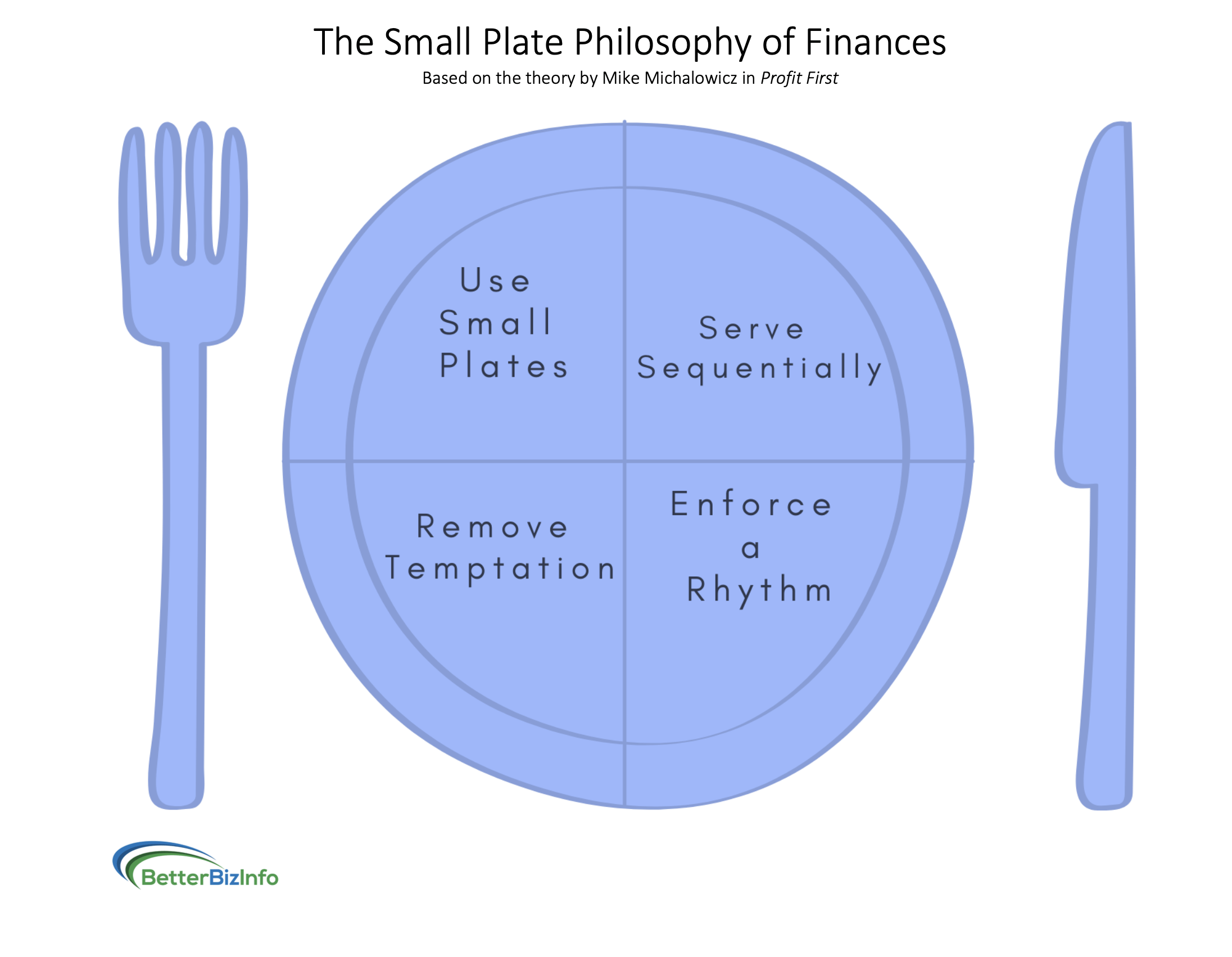
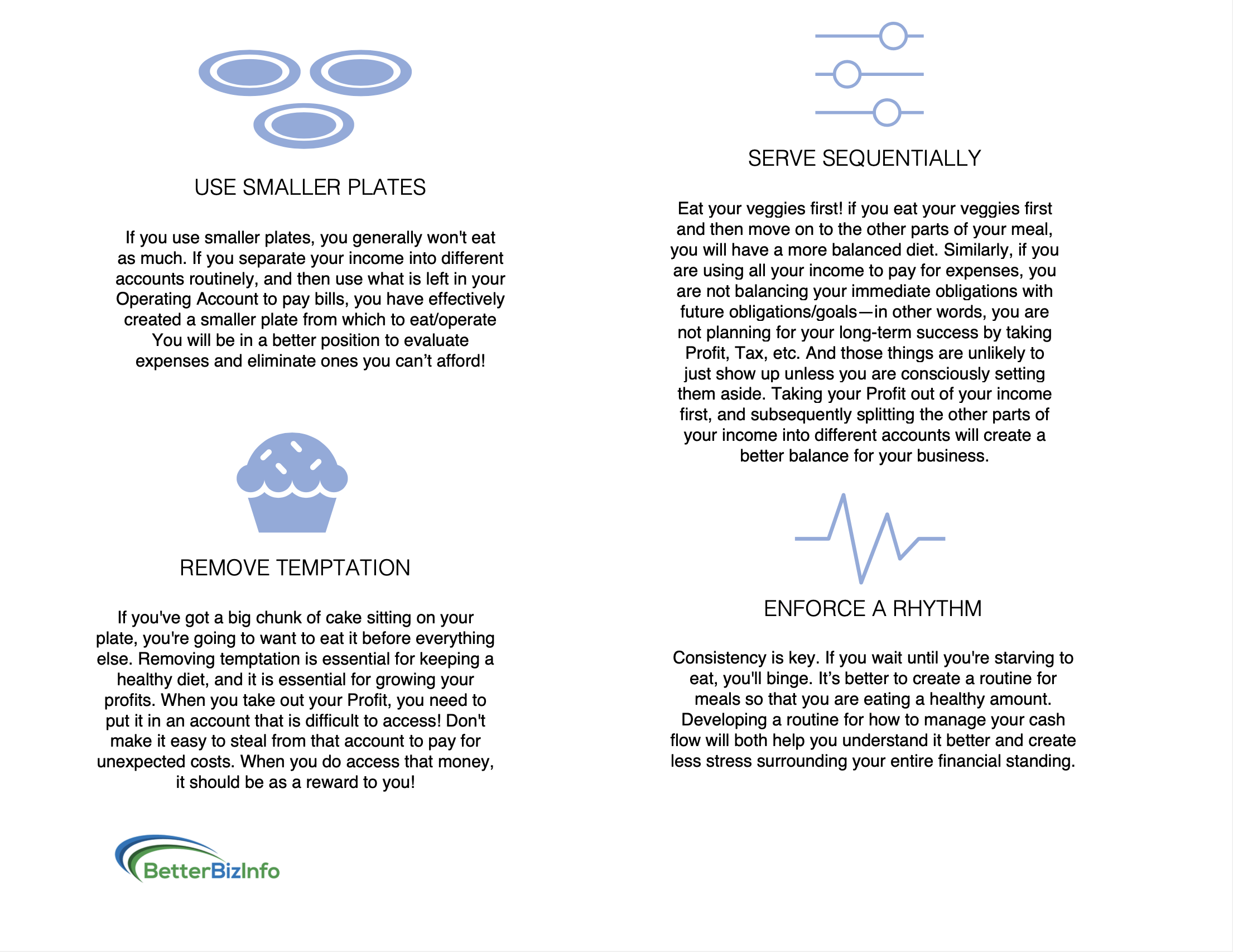
Mike Michalowicz, author of the best-seller book Profit First, often compares finances to diet. For both, there are a few core principle that are essential for creating a healthy balance in your life. Check out this worksheet to learn the 4 principles for creating an effective and healthy cash flow management system, called the Small Plate Philosophy!

Sign up for our newsletters here to get the first two chapters of Mike Michalowicz’s Profit First book for free, in which he explains the Small Plate Philosophy in depth! 

You can also check out how to create these “small plates” in your business by learning more about the Profit First system here!

Download the PDF version of this worksheet here.