by Adam Litster | Jun 13, 2025 | Entrepreneurship Newsletter
Perspective That Pays: Stepping Back to Drive Profit and Purpose
In this issue:
- Why nonstop hustle keeps owners lost, not liberated
- Connecting values, vision, and profit into a single internal compass
- Principle-first tactics that break the crisis loop
Why This Matters
If your calendar is full and your mind is tired, profit isn’t the only casualty—your values and vision suffer too. The longer we sprint inside the maze of day-to-day tasks, the easier it is to forget why we started and where we want to finish. That drift shows up as missed family moments, sleepless nights, and a bank account that never seems to match top-line sales.
The Entrepreneurial Pressure Cooker
At first glance the solution seems simple: just sell more. Yet when every new dollar comes with an equal—or larger—cost shadow, revenue feels like pouring water into a bucket with a hole. Popular slogans echo: you must spend money to make money, profits come with volume, owner gets paid last. But these often lead us down a slippery slope that’s hard to escape.
Life Inside the Maze, A Deeper Look
Picture eight-foot hedges stretching farther than you can see. You move down one corridor, hit a dead end, backtrack, then sprint into another wall of green. Time evaporates, and a voice whispers, “Move faster.” Speed inside the maze rarely equals progress.
Now imagine a silent lift carrying you one hundred feet into the sky. The labyrinth flattens into a tidy pattern, and three markers appear:
- The entrance: your original purpose and core values.
- The exit: your ideal life and business impact.
- The optimal path: turns that avoid dead ends and circles.
Stress recedes, because perspective breeds clarity. Inside the maze decisions feel binary and urgent—take a loan or miss payroll, discount or lose the client. Above the maze richer options surface—strengthen margins through efficiency, redirect marketing to your best buyers, refine your service mix to align with core strengths.
Values, Vision, and Profit: Your Three-Point Compass
From the aerial perch you can align three points that refuse to line up when you’re buried in daily fires:
- Values describe the non-negotiable standards for clients, team, and self.
- Vision paints your destination—revenue, lifestyle, impact, and freedom in three to five years.
- Profit funds the trip—the cash that guarantees values stay intact and the vision remains reachable.
When any point drifts, your compass spins. Anchor all three and every choice leads you closer to your ideal life.
Start With One Strategic Hour
Choose a single sixty-minute block this week—phone silent, door closed. In that hour:
- Review Reality: open bank balances, current commitments, and calendar load.
- Reconnect to Compass: revisit your written values and vision, note any drift.
- Identify One High-Leverage Move: tighten a process, reshape your offer for ideal clients, or cut a distracting project.
Anyone can protect one hour. As those moves extinguish recurring fires, expand the practice—ninety minutes, a half-day, eventually an entire Strategy Friday. Each expansion shifts your role from crisis manager to business architect.
Principle-First Tactics That Replace Panic
- Serve the Sweet-Spot Client: focus effort on buyers who respect quality and fit your culture.
- Constraints Spark Creativity: cap operating expenses as a share of revenue before they sprawl.
- Owner Pay Is Non-Negotiable: a business that can’t feed its owner is a hobby, not an asset.
- Kaizen Cash Flow: refine systems continuously—small improvements accumulate into large gains.
- Vision Filters Decisions: if an idea doesn’t move the compass toward the exit, let it pass.
Client Snapshot: From Crisis to Calm
A regional contractor survived for years by chasing any job, creating chaos and thin margins. During their first maze hour the owner saw a mismatch between their core value—craftsmanship—and the low-value projects filling the calendar. By trimming low-margin services, streamlining crew deployment, and requiring deposits before work began, cash flow smoothed and profitability rose—without chasing more volume. Most importantly, the owner reclaimed evenings for family and personal growth.
The Bottom Line
Running harder or faster inside the chaos just gets you to the wrong place faster. Elevate your view, connect values, vision, and profit, and guard one hour this week to begin.
Adam Litster
Certified Profit First Professional and Pumpkin Plan Strategist
(816) 500-5779 | adam@betterbizinfo.com

by Adam Litster | Jun 6, 2025 | Entrepreneurship Newsletter
Debt—Tool or Trap? Understand the Difference Before You Sign
In this issue:
- How inflation and tariff swings drive cash-flow stress
- A payroll-panic story that spiraled into crushing debt
- The three flavors of debt—what they are, real-world examples, and hidden costs
- A three-step plan: freeze new borrowing, build a timing reserve, and eliminate balances with a debt-snowball approach
Why Talk About Debt Now?
With inflation still seesawing and tariffs changing overnight, many businesses feel their cash cushions evaporate faster than expected. We’ve noticed a sharp rise in owners tempted by “instant” online loans or credit-card floats just to cover payroll. Quick cash can feel like relief—until the payments arrive and profit vanishes.
When a Payroll Loan Becomes an Anchor
One client had run lean and profitable—until discipline slipped. Profit and tax transfers paused, expenses crept up, and a $60 k payment from their largest customer came in late. Payroll was due Friday. A Stripe cash-advance offered funds in minutes. Perfect, the owner thought—until the balance lingered and snowballed into multiple high-interest loans that soon became the company’s biggest expense.
Stress and sleepless nights followed—proof that the “quick fix” had become a long-term burden.
The Three Flavors of Debt—Know What You’re Signing Up For
1. Investment Debt—Carefully Calculated
- Purpose: Acquire an asset designed to earn more than the loan costs.
- Example: Financing a new service truck expected to double daily jobs and add $200 k in annual revenue while payments total $120 k. The owner stress-tests the forecast and confirms profits cover the debt even if sales dip 20 percent.
- Why It Can Work: Cash flow from the asset repays the loan and then adds profit.
- Caution: Over-optimistic projections or unexpected downtime can turn a “good” loan into a drag.
2. Timing Debt—Risky, Often Avoidable
- Purpose: Bridge a cash gap between paying expenses now and receiving revenue later.
- Example: A contractor uses a $30 k line of credit to buy materials, expecting payment in 60 days. Weather delays shift payout to 90 days, interest accrues, and the balance sticks. The line of credit becomes semi-permanent.
- Why It Hurts: Interest erodes margins you thought were earned, and balances grow when timing slips.
- Better Path: Build an internal timing reserve so you fund these gaps with your own cash—interest-free.
3. Frivolous Debt—Never Worth It
- Purpose: Cover routine operating costs—payroll, rent, utilities—or factor invoices for quick cash. This debt produces no new revenue.
- Real Outcome: High interest becomes your company’s largest monthly outflow—as painful as adding a second payroll without any new staff.
- Why to Avoid: Adds high fees, masks overspending or underpricing, and compounds stress when payments come due.
Freeze, Reserve, Eliminate—A Principle-Based Plan
-
Freeze New Borrowing and Slash Non-Essential Spend
- Pause new loans and halt discretionary subscriptions for 30 days.
- Negotiate extended terms with key vendors.
- Channel every freed dollar to current balances—think of it as buying back your peace of mind.
-
Build a Timing Reserve—Be Your Own Bank
- Open a separate “Timing” account and transfer 2–5 percent of every customer deposit into it.
- Within a few months, cover material purchases, slow receivables, or minor emergencies with interest-free cash.
-
Eliminate Debt with the Snowball Method
- Choose a weekly “Debt Killer” transfer you can commit to consistently.
- Pay minimums on all balances, then attack the smallest principal first.
- Roll each freed payment into the next-smallest balance to build momentum and boost confidence.
The Bottom Line
In uncertain times, debt can look like the quickest route to calm, but unless it funds a clearly profitable investment, it often amplifies anxiety, drains profit, and steals sleep. Freeze new borrowing, build your own timing reserve, and dismantle existing balances with relentless focus. Your future self—and your balance sheet—will thank you.
Adam Litster
Certified Profit First Professional and Pumpkin Plan Strategist
(816) 500-5779 | adam@betterbizinfo.com

by Adam Litster | May 30, 2025 | Profit First, VPS, Entrepreneurship Newsletter
💡 Tip-of-the-Week
Vendor Call Blitz: Book two 15-minute calls this week asking suppliers for discounts or better terms.
In This Issue:
- Why trimming obvious expenses rarely fixes chronic cash strain
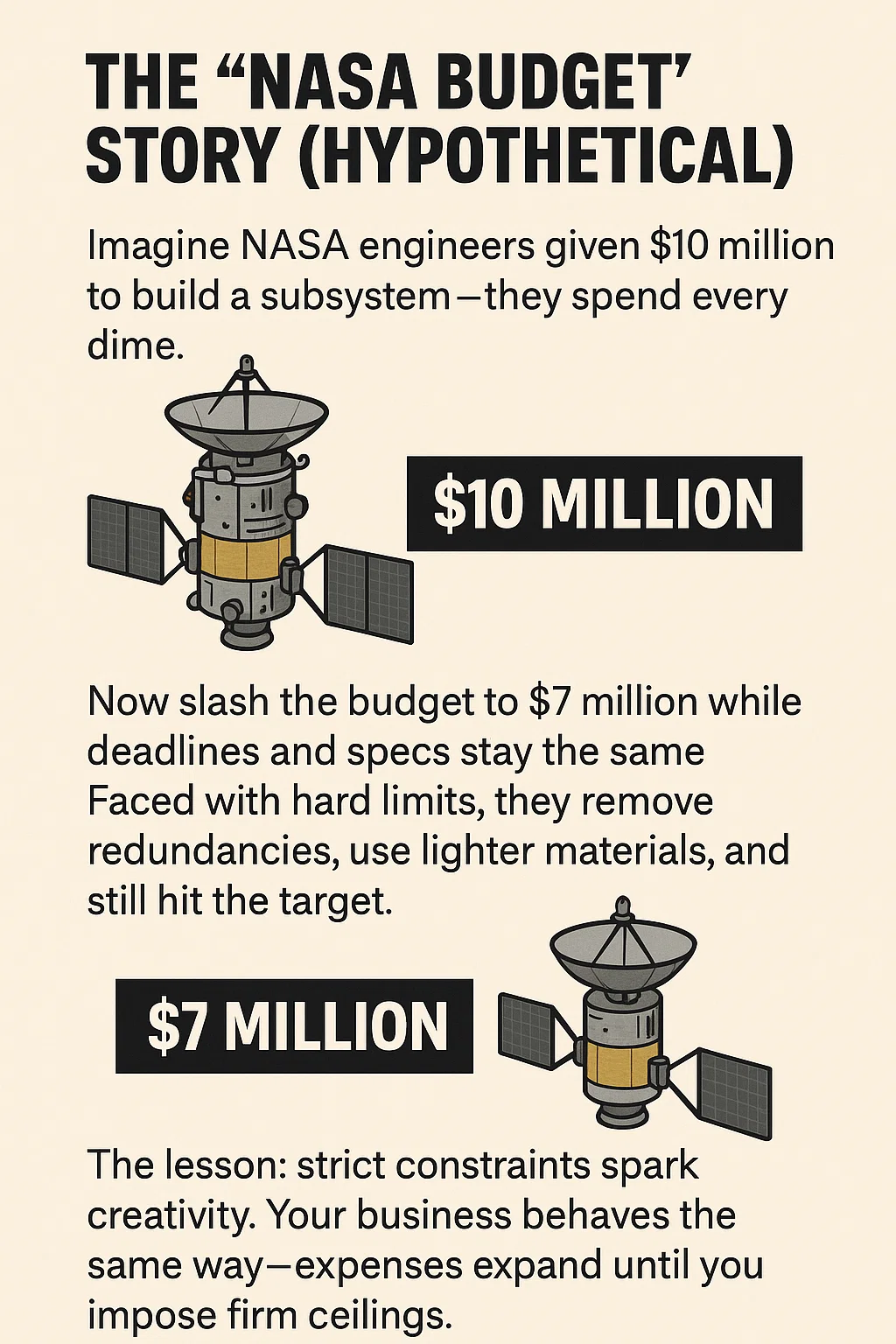
- The “NASA Budget” story and mindset shift
- How to match cost-cutting intensity to your financial health
- Five practical strategies to reach real, lasting profitability
- Tip-of-the-Week ideas to put theory into action
Why This Matters
Most owners begin an expense overhaul by going for the “low-hanging fruit”—cancelling duplicate software, dusty equipment leases, or forgotten subscriptions. We find that most businesses have between 5 and 15% of just waste—expenses that could be cut with no impact on revenue generation. Start by cutting those! That quick 5–15 percent cut feels good—until we find that operating costs still ride at too high of a percentage of revenue (your business expenses should be low enough to provide a healthy profit, pay the owner a good wage, and cover taxes).
After a few rounds of expense reviews you realize, “We’ve already cut the low-hanging fruit—what now?” It often feels impossible to see where else you can cut. This edition addresses the deeper layer of cost control and the mindset needed to uncover it.
The “NASA Budget” Lesson
Strict constraints spark creativity. Your business behaves the same way—expenses expand until you impose firm ceilings.
Mindset Reset: Redefining “Need”
Entrepreneurs in cash crunches often say, “I need that tool, that software, that employee (or fill in the blank) to run my business.” Ask instead: do you need it more than you need a viable company, a steady paycheck, and peace of mind? Every dollar must earn its keep. If it doesn’t create revenue or protect profit, it’s optional.
Pick Your Intensity: One Size Doesn’t Fit All
Before you dive into strategies for deep cuts or price moves, step back and ask, “How sturdy is my financial house right now?” Your answer guides how aggressively you apply the strategies that follow:
- Crisis Mode — Cash feels like sand slipping through your fingers; payroll is doubtful. You need bold, immediate cuts—pause projects and spending, sublet space, trim non-essential staff. Most importantly — STOP taking out any more debt!
- Survival Mode — Bills get paid but every month is tight. Use a scalpel, not a chainsaw: renegotiate contracts, replace expensive tools with leaner options, raise prices on high-value offerings.
- Improvement Mode — Profitable but below target margins. Focus on small inefficiencies, streamline processes, and double down on high-margin revenue plays.
The weaker your cash position, the stronger the medicine. Align action intensity with urgency so you neither under- nor over-react on the road to lasting profit.
Five Practical Strategies Beyond the Easy Cuts
1. Cut It All—Add Back Slowly
Run a thought experiment: you have zero discretionary budget for 30 days. Add back tools only when their absence blocks revenue. Most firms discover 10–20 percent of costs never return.
2. Cull Low- or Negative-Margin Products
Audit every offering. If it can’t clear your target gross margin, either reprice, bundle, or retire it. Resources freed here fund profitable lines.
3. Pair Aggressive Cuts with High-Margin Revenue Plays
- Upsell existing customers with premium add-ons they already trust you to deliver.
- Incremental price bumps (3–5 percent) on core services often go unnoticed by loyal buyers.
- Strategic alliances: cross-promote with complementary businesses to tap warm audiences at near-zero cost.
4. Systemize to Lower Labor Cost per Unit
Document one repeatable task each week; automate with no-code tools or delegate to lower-cost talent. When labor hours per sale drop, every future sale becomes more profitable.
5. If All Else Fails, Pivot the Model
After radical cuts and margin fixes, if you still can’t fund profit, tax, and a reasonable owner salary, the underlying model is broken. That may mean serving a narrower niche, charging value-based pricing, or launching a new revenue stream with healthier economics.
The Bottom Line
Lasting profitability emerges when you challenge every “need,” match tactics to financial reality, and innovate under constraints—like that hypothetical NASA team. Impose firm limits, rethink assumptions, and watch your business start funding your life instead of draining it.